
The End of Keywords: Why Machine-Readable AI Architecture Is the New E-commerce SEO
If you run an ecommerce brand doing £250K to £1M per year, chances are you’ve invested in ecommerce SEO. For years, that blueprint worked. Today, it’s structurally incomplete.
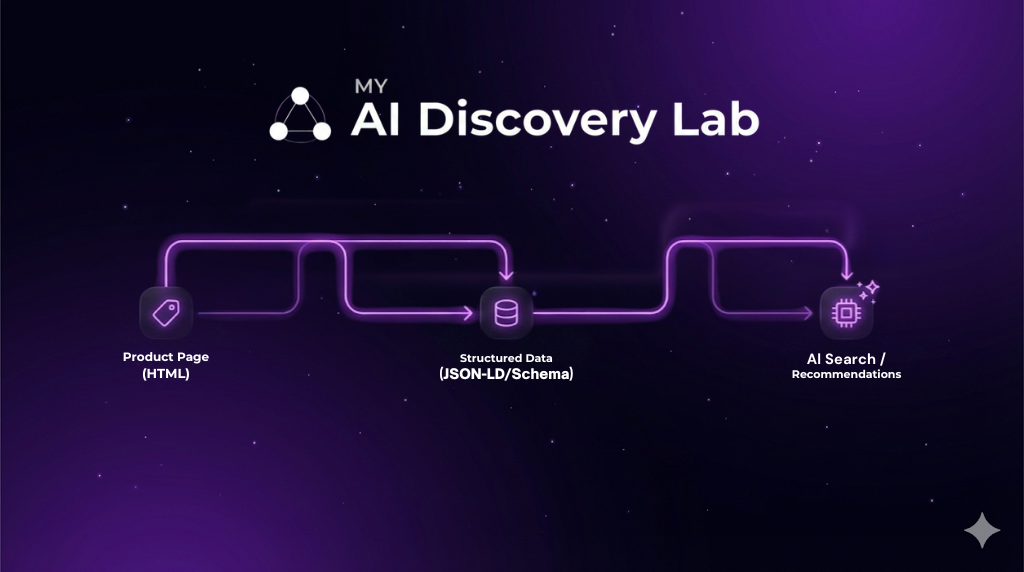
AI search engines like ChatGPT, Claude, Google AI Overviews, Gemini, and Meta’s AI systems are reshaping how customers discover and evaluate products. Buyers are no longer typing fragmented keywords into search bars and manually comparing ten open tabs.
They are asking AI to decide for them.
And AI does not evaluate your store the way Google did in 2015.
It evaluates entities. If your ecommerce infrastructure is not machine-readable, your brand is not ranked lower. It is simply ignored.
The Structural Shift: From Keyword SEO to Entity-Based AI Reasoning
Traditional ecommerce SEO is built around keywords and retrieval. It assumes a human user will click your listing, read your product description, compare your features, and make a decision.
AI search works differently.
When someone asks: “Find me a waterproof hiking backpack under £150 with a 30L capacity and recycled materials.”
An AI search engine does not scan for the keyword “best hiking backpack.” It searches for structured entities: product type, capacity, price constraint, material composition, waterproof rating, availability, reviews, brand credibility.
If those attributes are buried in paragraphs of unstructured HTML, the AI must infer. If it must infer, it loses certainty. If it loses certainty, it moves to a competitor whose product data is cleanly structured.
Ranking vs. Recommendation: The New Visibility Divide
Most founders still measure success by keyword position. But AI-driven commerce does not operate on “position 1–10.” It operates on inclusion.
When an AI generates a buying recommendation, it typically surfaces: 3–5 products, structured comparisons, summary reasoning, direct purchase pathways.
If your product is not machine-interpretable, you are not in the candidate set.
Your SEO dashboard may show green arrows and improving traffic. Meanwhile, AI recommendation layers quietly bypass you. This is the visibility crisis emerging across ecommerce — and it’s accelerating.
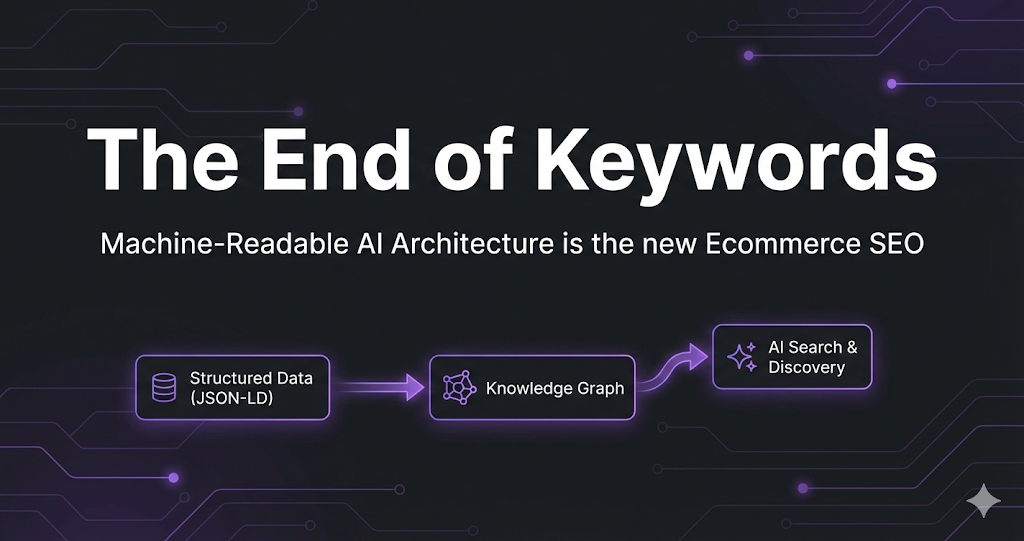
Why Structured Product Data Is Foundational
Many stores believe they “have structured data” because their platform outputs basic schema. That is baseline hygiene.
AI readiness requires explicit product entity typing, attribute-level clarity (size, weight, materials, compatibility), clean JSON-LD architecture, structured offers and availability, review and aggregate rating modelling, and consistent attribute naming across variants.
This is not cosmetic optimisation. It is product data architecture.
AI systems prioritise certainty. Structured data eliminates ambiguity. When your product catalog is machine-readable, AI systems can confidently interpret, compare, and recommend your inventory.
Without it, your brand exists only as visual pages, not as structured entities. AI does not “see” design. It sees data.
The Rise of AI-Driven Commerce and Agentic Systems
We are now entering the early stages of agentic commerce. AI systems are moving beyond answering questions. They are beginning to compare products autonomously, evaluate trade-offs, filter based on constraints, interact with APIs, and execute purchasing flows.
When autonomous AI agents evaluate your store, they do not browse like humans. They query structured data layers.
If your site requires scraping, guessing, or contextual inference, you introduce friction. AI agents default to brands that provide clean, interoperable, machine-readable product data.

The Competitive Advantage No One Is Measuring
Here is the uncomfortable truth: most ecommerce brands are structurally invisible to AI search engines.
Two brands may sell identical products. The brand with superior machine-readable product architecture is more likely to appear in AI-generated summaries, recommendation sets, comparison tables, and agent-driven shopping flows.
The Risk of Doing Nothing
If you ignore this shift, you may not see an immediate collapse in traffic. Instead, you will experience slower organic growth, reduced visibility in AI search engines, fewer recommendation inclusions, and lower top-of-funnel discovery from AI-driven commerce interfaces.
Your competitors will not outperform you because their copy is better. They will outperform you because their product data is machine-readable.
The Takeaway
The future of ecommerce SEO is not about chasing keywords. It is about engineering clarity.
AI search engines do not reward clever copy. They reward structured certainty.
If your store has never been evaluated for AI visibility, you are operating blind in the fastest-moving layer of product discovery.
Before you invest another pound in backlinks, ads, or traditional SEO optimisation, assess your AI visibility risk.