
Machine-readable product data infrastructure for AI discovery.
Variant-level offers. Attribute contracts. Structured data architecture. Built, validated, and governed.
- AI discovery depends on computable entities, not “readable pages”.
- Variants need per-variant Offer modelling to remove pricing/availability ambiguity.
- Attributes must be structured as contracts so machines can compare and filter.
- Validation prevents drift when themes/apps inject conflicting schema.
Right-side visual for the hero section.
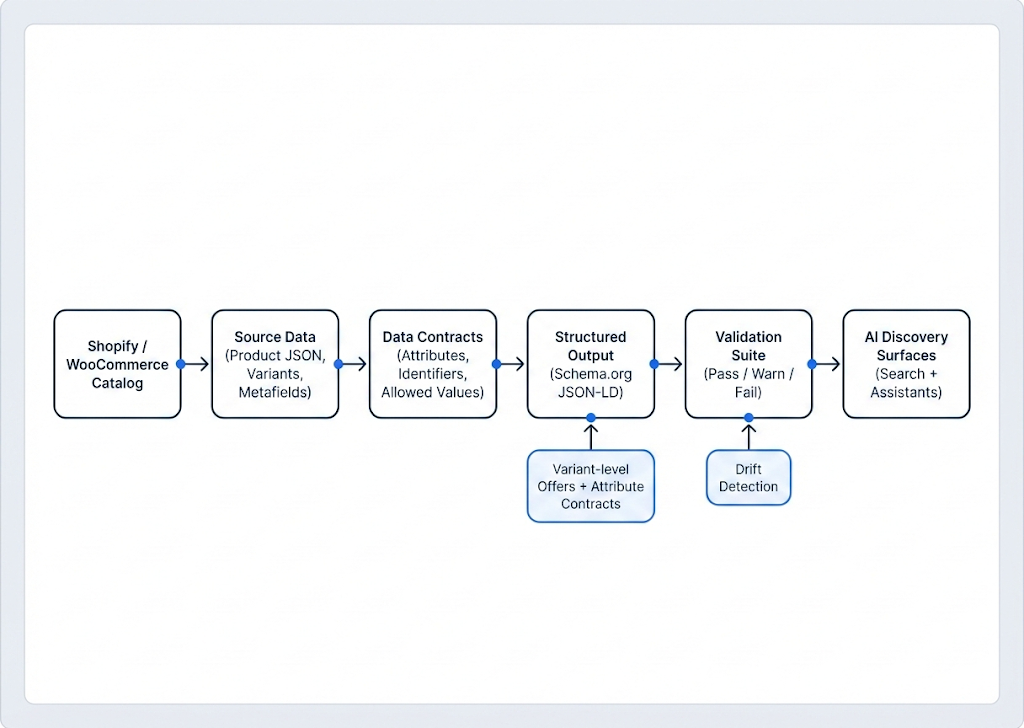
This is implementation-led infrastructure work — not SEO tactics, not content campaigns.
You’re SEO-visible. You’re structurally invisible to AI.
Most stores ship minimal schema by default, then accumulate conflicts from themes and apps. AI systems see ambiguity.
- Generic Product schema across catalogue
- Variant offers collapsed into ambiguity
- Attributes buried in product copy
- Duplicate schema conflicts from apps
- No validation or drift monitoring
Indexed doesn’t mean interpretable. AI discovery systems depend on consistent entity + attribute signals they can trust.
3 Pillars
Outputs-first infrastructure — you get shippable artifacts, not vague recommendations.
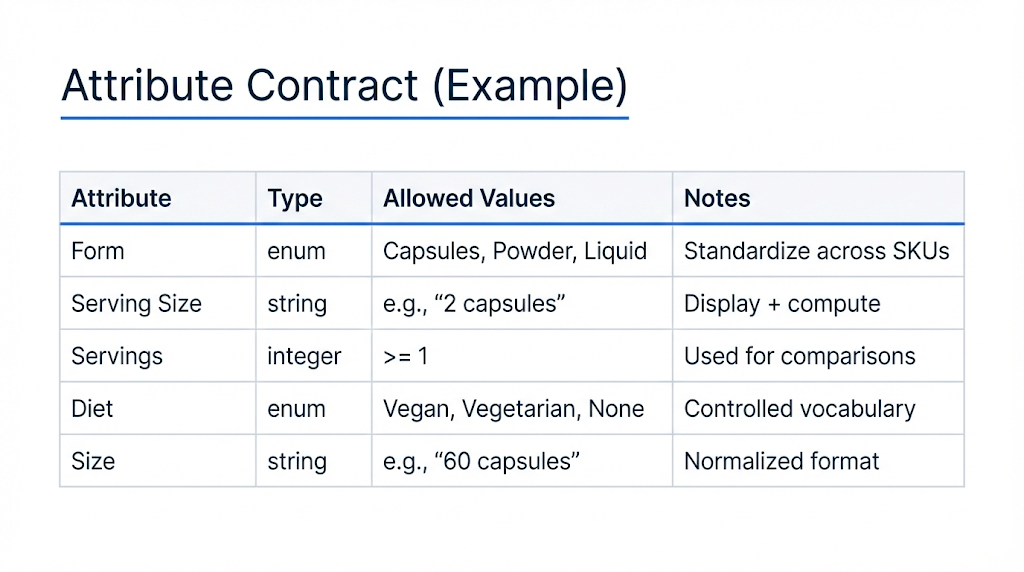
- Attribute contract spec (names, types, allowed values)
- Identifier strategy (SKU/GTIN rules, URL consistency)
- Template governance rules (what can inject schema)
- Per-variant Offer array modelling
- Price/currency/availability per SKU
- Canonical variant URLs + stable IDs
- Validator-ready JSON-LD examples
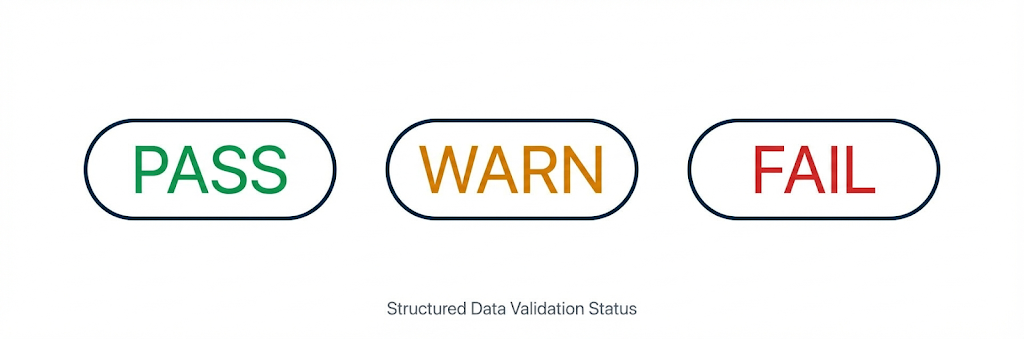
- Conflict detection (duplicate schema, mismatched offers)
- Ongoing drift checks + monthly health report
Method
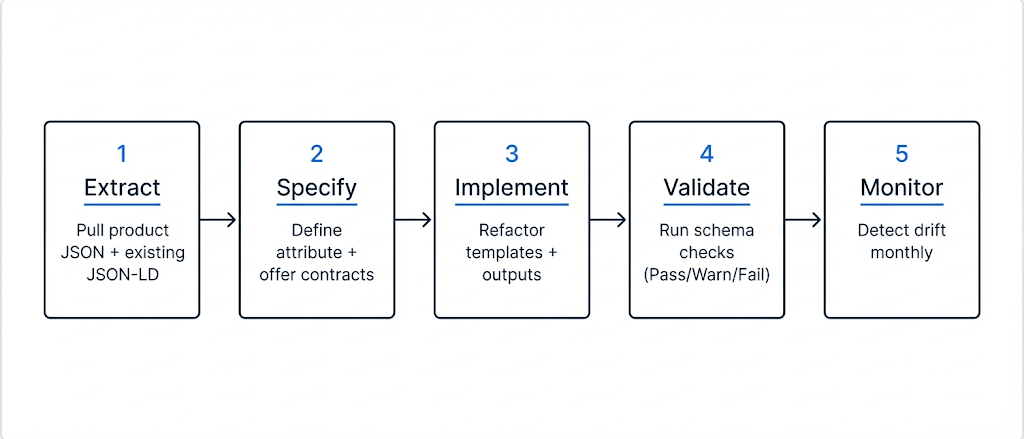
A clean, repeatable process: extract signals, specify contracts, implement the model, validate outputs, monitor drift.
Offer Ladder
Clear deliverables. No scattered services.
- 1–2 PDP review
- 3–5 structural issues identified
- What machines can/can’t read
- Catalogue-level issue register
- Implementation blueprint
- Validator-ready example JSON-LD
- Template architecture refactor
- Variant offer modelling across catalogue
- Validation suite setup
- Drift checks (schema conflicts, offer regressions)
- Structured data health report
- Change log recommendations
Proof (technical artifacts)
Examples of what gets fixed. These are structural artifacts — not marketing metrics.
{
  "issue": "Multiple Product JSON-LD blocks injected by apps + theme",
  "impact": "Conflicting offers/availability signals",
  "fix": "Single authoritative Product/Dataset block + guarded app injections"
}{
"before": "single Offer for multi-variant product",
"after": "offers: [ {sku, price, availability, url} per variant ]",
"result": "removes ambiguity in pricing + availability"
}
| Attribute | Type | Allowed |
|---|---|---|
| Form | enum | Capsules / Powder / Liquid |
| Servings | integer | >= 1 |
| Size | string | Standardized per SKU |
FAQ
Will this break my theme? +
No. We refactor the structured layer (JSON-LD and data contracts) while keeping your storefront rendering intact.
How do you handle app-injected schema? +
We identify duplicates and conflicts, then define a single authoritative structured output with guarded injections.
How do you model variants? +
Per-variant Offer arrays with consistent SKU/GTIN where available, stable URLs, and clear availability/pricing per option.
How do you prevent drift? +
Validation-first delivery plus monitoring: detect regressions when themes, apps, or content changes modify structured output.
What platforms do you support? +
Shopify, WooCommerce, headless, and custom storefronts — we focus on the structured layer that machines interpret.